jueves, 22 de noviembre de 2018

AGOSTO 2018 - MÉXICO (PENÍNSULA DEL YUCATÁN) (2/5): COSTA ESTE AL SUR DE PLAYA DEL CARMEN / EAST COST SOUTH TO PLAYA DEL CARMEN (AKUMAL, TULUM Y SIAN KA'AN)

Tras nuestra visita a la isla de Cozumel, nos dirigimos a la zona de Akumal, ya dentro de la península del Yucatán. Allí pernoctamos durante un total de 7 noches. Akumal se encuentra en la costa este de la península del Yucatán, entre las poblaciones de Tulum, al sur, y de Playa del Carmen, la norte. Es la principal zona turística de la costa este, llena de hoteles y atracciones de diversa índole. En esta entrada muestro las principales visitas y observaciones realizadas al sur de Playa del Carmen, hasta la Reserva de la Biosfera de Sian Ka'an.

Following Cozumel, we moved to the area of ​​Akumal, within the Yucatan peninsula itself, where we spent 7 nights. Akumal is located on the east coast of the Yucatan Peninsula, between the towns of Tulum, to the south, and Playa del Carmen, to the north. It is the main tourist area of ​​the east coast, full of hotels and a variety of attractions. In this post I show the main visits and observations made south to Playa del Carmen, until the Sian Ka'an Biosphere Reserve.


Puntos visitados en la península del Yucatán (México)

La crónica de viaje de eBird, junto con el mapa de las principales zonas visitadas y la lista de aves observadas en los estados de Yucatán y Quintana Roo, puede encontrarse en este enlace.

The eBird trip report, showing a map with the main visited locations, together with the complete list of bird species seen in the states of Yucatán and Quintana Roo, can be seen in this link.

1. Akumal (jardines del complejo hotelero Bahía Príncipe).

Estuvimos alojados durante las 7 noches en un apartamento situado dentro del complejo hotelero Bahía Príncipe. Esta zona hotelera cuenta con unas zonas ajardinadas muy extensas (como se puede ver en la imagen inferior), con zonas de selva entremezcladas con campos de golf y edificaciones. Aunque mi primera intención era levantarme temprano, coger el coche y visitar zonas cercanas, para luego regresar a recoger a la familia, las distancias en la zona resultaron mayores a lo previsto y no me dio tiempo a realizar lo que había pensado. En su lugar, decidí aprovechar cada mañana para pajarear desde el amanecer por los jardines del complejo, durante un par de horas. La verdad es que resultó interesante, y con una avifauna variada (28 especies), que podéis ver aquí.

We spent 7 nights in an apartment located within the Bahía Príncipe hotel complex. This complex has extensive gardens (as can be seen in the image below), with jungle areas interspersed with golf courses and buildings. Although my first intention was to wake up early, take the car and visit nearby areas, and afterwards return to pick up the family, the distances in the area were greater than expected and I did not had time to do what I planned. Instead, every morning I used to bird from the dawn through the complex gardens, for a couple of hours. In fact, it was interesting, and I saw a wide variety of birds (28 species), that you can see here.

Cenote en el TAO Wellness Center

Chachalaca norteña / Plain chachalaca (Ortalis vetula)

Carpintero frentidorado / Golden-fronted woodpecker (Melanerpes aurifrons)

Carpintero frentidorado / Golden-fronted woodpecker (Melanerpes aurifrons)

Momoto cejiazul / Turquoise-browed motmot (Eumomota superciliosa)

Amazilia canela / Cinnamon hummingbird (Amazilia rutila)

Tirano melancólico / Tropical kingbird (Tyrannus melancholicus)

Tirano silbador / Couch's kingbird (Tyrannus couchii)

Bienteveo sociable / Social flycatcher (Myiozetetes similis)

Bienteveo común / Great kiskadee (Pitangus sulphuratus)

Bienteveo pitanguá / Boat-billed flycatcher (Megarynchus pitangua)

Zorzal pardo / Clay-colored thrush (Turdus grayi)

Anambé degollado / Rose-throated becard (Pachyramphus aglaiae)

Vireo verdiamarillo / Yellow-green vireo (Vireo flavoviridis)

Turpial dorsidorado / Yellow-backed oriole (Icterus chrysater)

Turpial enmascarado / Hooded oriole (Icterus cucullatus)

Zanate cantor / Melodious blackbird (Dives dives)

Agutí de Centroamérica / Central american agouti (Dasyprocta punctata)

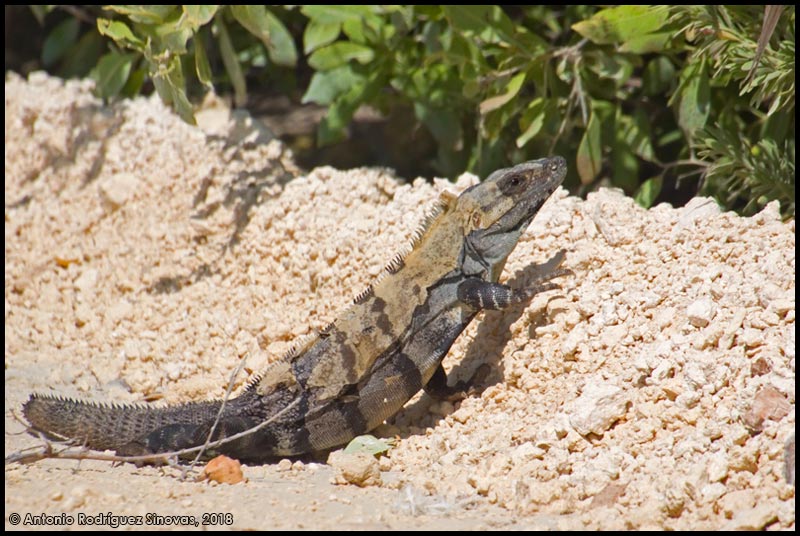
Iguana negra de cola espinosa / Common spiny-tailed iguana (Ctenosaura similis)

Hormiga carpintera bronceada (Camponotus sericeiventris)

Rhopalophora rubecula

2. Parque Nacional Tulum.

Tulum es una localidad de la península del Yucatán conocida por las bien conservadas ruinas de la antigua ciudad portuaria maya. El edificio principal es una gran estructura de piedra llamada El Castillo, que se asienta sobre un acantilado rocoso que acaba en una playa de arena blanca y un mar color turquesa. Alrededor de las ruinas, e incluyéndolas, se encuentra el parque nacional Tulum, una zona costera con manglares y cenotes. La lista de especies de aves (8) observadas en esta zona, junto con más fotografías y su localización exacta, pueden encontrarse en este enlace.

Tulum is a town on the Yucatan Peninsula known for the well-preserved ruins of the ancient Mayan port city. The main building is a large stone structure called El Castillo, which sits on a rocky cliff that ends on a white sand beach and a turquoise sea. Around the ruins, and including them, is the so-called Tulum National Park, a coastal area with mangroves and cenotes. The list of bird species (8) observed in this area, together with more pictures and their exact location, can be found in this link.

Ruinas de Tulum

Coatí pizote / White-nosed coati (Nasua narica)

Ruinas de Tulum

Rabihorcado magnífico / Magnificent frigatebird (Fregata magnificens)

Ruinas de Tulum, El Castillo

Turpial yucateco / Orange oriole (Icterus auratus)

3. Reserva de la Biosfera de Sian Ka'an - Muyil.

La Reserva de la Biosfera de Sian Ka’an es la mayor área protegida del Caribe mexicano y ocupa aproximadamente 650.000 hectáreas a lo largo de 120 kilómetros de Norte a Sur, entre los municipios de Tulum y Felipe Carrillo Puerto. Comprende playas, dunas, cenotes, arrecifes de coral y una selva tropical, donde habitan más de 300 especies de aves y más de 1000 de plantas. Sian ka’an significa “donde nace el cielo” en maya y fue declarada Patrimonio de la Humanidad por la Unesco en el año 1987. Los accesos a la reserva son escasos, lo cual dificultó bastante la visita. Además de un acceso desde la ciudad de Felipe Carrillo Puerto, muy utilizado por los ornitólogos, pero muy lejos de la zona donde estábamos alojados, la reserva se puede visitar por la zona de la Laguna y las ruinas de Muyil (noroeste de la reserva) o por la carretera sin asfaltar que, atravesando Boca Paila, llega a Punta Allen (parte este). Empezamos a visitarla por la pequeña ciudad maya de Muyil, y posteriormente hicimos una salidad en barca a la laguna de Muyil y al canal maya. En esta zona sólo hay un pequeño sendero que une las ruinas con la laguna, que no nos dio tiempo a recorrer. En cualquier caso, merecería la pena que ampliasen un poco más la oferta de senderos por la zona. La lista de especies de aves (5) observadas en esta zona, junto con más fotografías y su localización exacta, pueden encontrarse en este enlace.

The Sian Ka'an Biosphere Reserve is the largest protected area in the Mexican Caribbean and occupies approximately 650,000 hectares along 120 kilometers from North to South, between the municipalities of Tulum and Felipe Carrillo Puerto. It includes beaches, dunes, cenotes, coral reefs and a tropical jungle, with more than 300 species of birds and more than 1000 of plants. Sian ka'an means "where the sky is born" in Mayan and was declared a World Heritage Site by Unesco in 1987. Access to the reserve is scarce and difficult to get. In addition to an access from the town of Felipe Carrillo Puerto, very used by ornithologists, but very far from our apartment, the reserve can be visited from the Muyil lagoon and ruins (northwest of the reserve) or through the dirt road that, crossing Boca Paila, arrives to Punta Allen (east part). We began our visit by the small Mayan city of Muyil, and later we made a boat tour to the Muyil lagoon and the Mayan channel. In this area there is only a small trail that connects the ruins with the lagoon, which we did not have time to travel. In any case, it would be worthwhile to extend the offer of trails in this area. The list of bird species (5) observed in this area, together with more pictures and their exact location, can be found in this link.

Ruinas de Muyil, El Castillo

Trogón cabecinegro / Black-headed trogon (Trogon melanocephalus)

Basilisco marrón / Brown basilisk (Basiliscus vittatus)

Manglar en la Laguna de Muyil

4. Reserva de la Biosfera de Sian Ka'an - Boca Paila y Punta Allen.

La carretera sin asfaltar que llega hasta Punta Allen, al este de la reserva, ofrece buenas oportunidades para la observación de fauna. Sin embargo, llegar desde Tulum hasta Punta Allen toma casi 4 horas de coche, por un camino muy bacheado, que obliga al uso de todoterrenos. En general se recomienda contratar una salida en 4x4 que, lamentablemente, están dirigidas al público general y no realizan más que una parada por en medio para ver el paisaje. Eso sí, suelen incluir una salida en barca para ver tortugas o delfines. Es una pena porque no aprovechan correctamente las oportunidades que ofrece la reserva para el naturalista. Personalmente, si volviese a ir no intentaría llegar a Punta Allen (o mejor, dormiría allí), lo haría por mi cuenta, pajareando en ruta, o tomando una salida en barca desde Boca Paila. En cualquier caso, la lista de especies de aves (25) observadas en esta zona, junto con más fotografías y su localización exacta, pueden encontrarse en este enlace.

The unpaved road that leads to Punta Allen, located in the east of the reserve, offers good opportunities for wildlife observation. However, getting from Tulum to Punta Allen takes almost 4 hours by car, along a very bumpy road, which forces the use of 4x4 cars. In fact, it is recommended to hire a tour in 4x4 that, unfortunately, are aimed at the general public. They only do a single stop in between to see the landscape. Of course, they usually include a boat trip to see turtles or dolphins. It is a pity because they do not take advantage of the opportunities offered by the reserve for the naturalist. Personally, if I have to return to the reserve any day I would not try to get to Punta Allen (unless slepping there), I would do it on my own, birding en route, or taking a boat trip from Boca Paila. The list of bird species (25) observed in this area, together with more pictures and their exact location, can be found in this link.

Costa cerca de Boca Paila

Rabihorcado magnífico / Magnificent frigatebird (Fregata magnificens)

Manglar en Sian Ka'an

Cormorán orejudo / Double-crested cormorant (Nannopterum auritus)

Avetigre mejicana / Bare-throated tiger-heron (Tigrisoma mexicanum)

Avetigre mejicana / Bare-throated tiger-heron (Tigrisoma mexicanum)

Ibis blanco / American white ibis (Eudocimus albus)

Columbina común / Common ground-dove (Columbina passerina)

Tortuga verde o prieta / Green turtle (Chelonia mydas)

Cocodrilo americano / American crocodile (Crocodylus acutus)

martes, 20 de noviembre de 2018

AGOSTO 2018 - MÉXICO (PENÍNSULA DEL YUCATÁN) (1/5): ISLA DE COZUMEL

Considerada un auténtico paraíso por turistas llegados desde todos los puntos del globo, la isla de Cozumel sorprende por su naturaleza tropical, desbordante y virgen, apenas perturbada, y que combina áreas selváticas, sobrecogedores manglares, e impactantes lagunas de intensos colores, con playas de cine y un fondo marino surcado por una increíble barrera coralina. Esta isla fue el inicio de nuestro viaje por la península del Yucatán, en México, un destino turístico por excelencia. Únicamente estuvimos dos noches en Cozumel, pero sirvió como excelente inicio de nuestro viaje a México, en el que combinamos la observación de fauna con el turismo de tipo cultural.

Considered an authentic paradise by tourists arriving from all over the globe, the island of Cozumel surprises with its tropical and virgin nature, barely disturbed, and combines jungle areas, breathtaking mangroves, and stunning lagoons of intense colors, with beautiful beaches and a seabed crossed by an incredible coral barrier. This was the beginning of our trip through the Yucatan peninsula, in Mexico. We only stayed two nights in Cozumel, but it served as an excellent start to our trip in Mexico, in which we combined wildlife observation with cultural tourism.


Puntos visitados en la península del Yucatán (México)

La crónica de viaje de eBird, junto con el mapa de las principales zonas visitadas y la lista de aves observadas en los estados de Yucatán y Quintana Roo, puede encontrarse en este enlace.

The eBird trip report, showing a map with the main visited locations, together with the complete list of bird species seen in the states of Yucatán and Quintana Roo, can be seen in this link.

1. Alrededores del hotel Allegro Cozumel.

Las primeras observaciones de aves las hicimos en los jardines y en los alrededores del hotel en el que estábamos alojados, el Allegro Cozumel, en la zona suroeste de la isla, dentro del Parque Nacional Arrecifes de Cozumel. La lista de especies de aves (28) observadas en esta zona, junto con más fotografías y su localización exacta, pueden encontrarse en este enlace.

The first bird sightings were made in the gardens and around the hotel where we were staying, the Allegro Cozumel, in the southwest area of ​​the island, within the Arrecifes de Cozumel National Park. The list of bird species (28) observed in this area, together with more pictures and their exact location, can be found in this link.

Turpial enmascarado / Hooded oriole (Icterus cucullatus)

Sisonte tropical / Tropical mockingbird (Mimus gilvus)

En la playa apareció algún chorlitejo piquigrueso, junto con colombinas comunes y zanates mexicanos.

In the beach there were some Wilson's plovers, together with common ground-doves, and great-tailed grackles.

Playa / Beach (hotel Allegro Cozumel)

Chorlitejo piquigrueso / Wilson's plover (Anarhynchus wilsonia)

Columbina común / Common ground-dove (Columbina passerina)

Zanate mexicano / Great-tailed grackle (Quiscalus mexicanus)

Y en los jardines del hotel y alrededores, abundaban especies como el carpintero yucateco, las columbinas coloradas, los añaperos garrapena, alguna esmeralda de Cozumel, y una abundante migración de hirundínidos.

An in the gardens and around the hotel, there were species like Yucatan woodpecker, ruddy ground-doves, lesser nighhawk or Cozumel emerald, together with and abundant migration of swallows and martins.

Carpintero yucateco / Yucatan woodpecker (Melanerpes pygmaeus)

Vencejo de Vaux / Vaux's swift (Chaetura vauxi)

Paloma coronita / White-crowned pigeon (Patagioenas leucocephala)

Columbina colorada / Ruddy ground-dove (Columbina talpacoti)

Añapero garrapena / Lesser nighthawk (Chordeiles acutipennis)

Esmeralda de Cozumel / Cozumel emerald (Cynanthus forficatus)

Tirano melancólico / Tropical kingbird (Tyrannus melancholicus)

Pájaro gato negro / Black catbird (Melanoptila glabrirostris)

Platanero / Bananaquit (Coereba flaveola)

Semillero tomeguín / Yellow-faced grassquit (Tiaris olivaceus)

Golondrina purpúrea / Purple martin (Progne subis)

Golondrina purpúrea / Purple martin (Progne subis)

Golondrina pechigrís / Grey-breasted martin (Progne chalybea)

Golondrina pueblera / Cave swallow (Petrochelidon fulva)

Anolis marrón / Brown anole (Anolis sagrei)

Iguana negra de cola espinosa / Common spiny-tailed iguana (Ctenosaura similis)

Justo enfrente del hotel hay una zona de mosaico, con selva y algunas zonas encharcables, que dieron lugar a buenas observaciones. Además de coatís pizotes, en la zona descansaban zopilotes y auras gallipavo, chorlitejo culirrojo, columbina colorada, y varios paseriformes.

Just in front of the hotel there is a mosaic area, with jungle and some flooded fields, which gave rise to good observations. In addition to white-nosed coatis, in the area roosted several american black and turkey vultures and there were species like killdeer, ruddy ground-dove and passerines.

Coatí pizote / White-nosed coati (Nasua narica)

Zopilote negro / American black vulture (Coragyps atratus)

Garceta grande / Great white egret (Ardea alba)

Chorlitejo culirrojo / Killdeer (Charadrius vociferus)

Columbina colorada / Ruddy ground-dove (Columbina talpacoti)

Perlita grisilla / Blue-grey gnatcatcher (Polioptila caerulea)

Cangrejo ermitaño caribeño / Caribean land hermit crab (Coenobita clypeatus)

2. Punta Sur Eco Beach Park y alredores.

El Punta Sur Eco Beach Park se encuentra, como su nombre indica, en la punta sur de la isla, y es una zona muy interesante desde el punto de vista del naturalista. Contiene, además de una bonita playa con los arrecifes cercanos, lagunas interiores, vegetación litoral, y muy cerca unos campos inundados donde vimos jacanas, suirirí piquirrojo y ciervo de cola blanca. Curiosamente, no lo he visto comentado en blogs de ornitólogos que han visitado la isla anteriormente, pero creo que merece la pena visitarlo. La lista de especies de aves (24) observadas en el Beach Park (junto con más fotografías y su localización) puede verse en este enlace. Por otro lado, las de los campos inundados (7), pueden verse aquí.

Punta Sur Eco Beach Park is located, as its name suggests, at the southern end of the island, and is a very interesting area from the point of view of the naturalist. It contains, in addition to a beautiful beach with its nearby reefs, inland lagoons, coastal vegetation, and very close to it, some flooded fields where we were able to see jacanas, black-bellied whistling-duck, and white-tailed deer. It was somehow surprising that I was not able to find any birding trip report including a visit to this area, but anyway, I think that it merits a visit. The list of bird species (24) observed in the Beach Park, together with more pictures and its exact location, can be found in this link. In addition, that of the flooded fields (7) can be found here.

Ciervo de cola blanca / White-tailed deer (Odocoileus virginianus)

Suirirí piquirrojo / Black-bellied whistling-duck (Dendrocygna autumnalis)

Jacana centroamericana / Northern jacana (Jacana spinosa)

Punta Sur Eco Beach Park

Correlimos menudillo / Least sandpiper (Calidris minutilla)

Chorlitejo semipalmeado / Semipalmated plover (Charadrius semipalmatus)

Chorlitejo piquigrueso / Wilson's plover (Anarhynchus wilsonia)

Chorlito gris / Grey plover (Pluvialis squatarola)

Reinita de manglar / American yellow warbler (Setophaga petechia)

Punta Sur Eco Beach Park

Garceta rojiza / Reddish egret (Egretta rufescens)

Garcilla verde / Green heron (Butorides virescens)

Punta Sur Eco Beach Park, Vestigio maya de El Caracol

Iguana negra de cola espinosa / Common spiny-tailed iguana (Ctenosaura similis)

Iguana negra de cola espinosa / Common spiny-tailed iguana (Ctenosaura similis) (juvenil)